Monday, February 28, 2011

Radiologists without Borders Visit

Dr. Ron hanging out with some of the kids at Pou Soley Leve

Dr. Ron teaching the children about bones and joints

The rice donated from J/P HRO

RWB headed home
Rose and Dave

Me, Shelly, Rose, and Dave carrying donated rice

Shelly, Dave, Chris, Rose, Ron and I carrying boxes of rice

Chris and Dr. Ron carrying the donated rice

RWB and the children of Pou Soley Leve
Chris with his students at J/P HRO hospital

Chris teaching some x-ray techs at the J/P HRO hospital

Brian and Shelly talking before Shelly went to train some mid-wives at the J/P HRO hospital

Chris with his graduated students at J/P HRO hospital
Let me fill you in on the last two weeks...
On Wednesday the 9th we picked up 5 members of Radiologists Without Borders (RWB) who included Dr. Ron Israelski, Christopher Moreno, Shelley Benson, Brian Wetzel, and Dave Kerr. On their first day here we took them to the General Hospital so they could distribute the lead vests for the x-ray techs they brought with them. After that it was starting to get dark so we headed home to eat and discuss the rest of the week. The next day we dropped off the crew at the hospital while Yvon, Greg and I went to J/P HRO to pick up 30 boxes of food they were donating to Pou Soley Leve. When we went to pick up the RWB they told us about a 14 year old boy who got caught in a fight and his forearm was now cut deeply and the nerves had been cut as well so he couldn’t move his wrist and hand. Friday morning we went to the General Hospital so Dr. Ron could try to do what he could for the boys arm and for the rest of the team to fix one of the x-ray machines that hadn’t been working. Around 11 am we took Chris, Brian and Shelly up to the J/P HRO hospital so they could train some of the x-ray techs up there and to train some of the mid-wives on how to use the ultra sound machines they have. Chris was training 3 of the x-ray techs on how to use on of their portable x-ray machine and Shelly went over to the maternity section to train them on the different things they could do with the ultra sound machine. Dr. Ron was able to complete the surgery on the young boy but will have to do some follow up surgery when he comes back in a few months. That night we had a dinner party for all of the people who helped the RWB while they were here. Some of the doctors and interns came and everyone talked and made plans for future visits and what can be done to improve the hospital. Before they left for the airport we went up to Gilbert to drop off the rice that we had received from J/P HRO a few days prior. After we helped the kids carry the boxes, Dr. Ron proceeded to give the kids a lesson on the leg bones and the arm bones. When he was demonstrating joints by moving his leg in circles the kids copied him and everyone started laughing. We could only stay for about 15 minutes because they had to catch a flight back home. They are planning to come back though this summer to train some more people and to bring more doctors back to the hospital. It was sad to see them go since they were here for such a short time but we have all made plans to continue the work we are doing back in the states and down here.

Thursday, February 24, 2011

Let me paint you a picture..

I am awakened at 6:30 am either by the roosters downstairs or by the construction workers across the street. I doze in and out of sleep until about 7:15 when I hear the playful laughter of children on the way to school. As I wake up and get ready, I listen to the rest of the city already on their way to work. I begin to hear the honking of the cars as they warn pedestrians and other drivers to stay out of the way. Depending on what is going on for the day, I may go up to the J/P HRO camp to bring the mechanics up to work on the cars. If they find out they need a part then we head downtown to more of the industrial part of town passing the presidential palace which collapsed on itself. The sun reflects off the painted white, making it contrast that much more from the bright green of the lawn that it sits on. There are tents surrounding what once were parks all around the adjacent streets. Presidential candidate’s names are spray painted around the concrete perimeter while posters of the same candidate’s posters have been glued to the green wrought iron fences which line the lawn. People have taken up the sidewalk space selling everything from phone credit to used clothes to freshly cooked food. As we wind through the traffic, which at first glance seems to have no structure to it but upon further inspection there is a certain chaotic method of getting through the newly formed one way streets due to the dumping of rubble into the already broken and pot-holed filled roads, we have to make our way around the tap-taps which are basically trucks with a covering over the bed and benches for the customers to sit on. They are usually filled with people and have others hanging on in the back while blasting the latest hip-hop and rap songs. Driving through the streets of downtown a mixture of exhaust, rotting garbage, and food cooking overcome the area. As we drive by some women selling oranges and peeling them for their customers we may just get lucky enough to get a whiff of the citrus filling the air but only briefly as we pass by.  Dogs wander the streets usually limping along on three good legs either because of being hit by cars or any other numerous reasons.  On our way back from downtown we pass women walking around with live chickens held upside down who stop in from of each store window holding them up to entice a potential customer. Heading back up the hill in traffic and the mid-day sun the drink sellers walking alongside the cars seem to look more and more tempting as the minutes turn into an hour or two. By the time we get back up to the cars we started working on in the morning it is now turning into late afternoon so the mechanic packs up his tools and we make plans to finish the work the next morning. If I have learned one thing so far it is to not make plans because there is always something that comes up to change them so just go with it because there is nothing else you can do about it. As soon as the sun begins to sets, all of the sellers on the streets pack up and head to wherever they call home and the night street food sellers and tent bars begin to get ready for the evening customers. The sun sets very quickly and once it is gone the temperature drops rapidly. Not enough to feel a chill, but just enough to feel al of the heat from the day disperse only to come back in a few hours. Things begin to get quite on the streets around the house around 8 or 9 and after 10 there is hardly any traffic to be heard except for downtown off into the distance. The late night is the best time to get anything done since no one is using the internet and this time of night is the only quite I get throughout the day. Pretty soon my eyes will no longer be able to stay open and I will go off to sleep for a few hours only to do it all over again once I wake. 

Sunday, February 6, 2011

Fixing the fleet


This past week started off on a good note. There is a boy, Jeff, who lives about an hour away from Port-Au-Prince who Dr. Bonnet (The doctor who started SantéBus, the program I am here with) met while he was here last year. Jeff is trying to obtain a visa to be allowed to study in New Jersey and stay with the Bonnet family. On Sunday, Jeff and his mother arrived in Port-Au-Prince to spend the night since they had a meeting at the embassy at 7:30am. We all went to the embassy Monday morning but Jeff was not allowed to have anyone accompany him since he was over 18 and under 79 so we waited in the car for 3 and a half hours until his interview was over. He would have been granted the visa but the school he is going to be attending put his name as Jeffery on the form and on his passport is says Jeff, so the school has to send a new letter down and then he go to the embassy and get his visa.

Monday afternoon I went to meet with one of the owners of the Hotel Montana, Nadine, Aleda, one of the co-founders of We Advance (http://weadvance.org/index.php), which is opening a clinic in Cite Soleil (one of the poorest and most dangerous cities in the western hemisphere), and Adam, the founder and president of Global DIRT (disaster immediate response team, http://www.globaldirt.org/) which specializes in emergency patient transfers by working with clinics and the General Hospital.

A brief history about Nadine and the Hotel Montana: The Hotel was built in 1946 and was a well-known 4-star tourist hotel with 146 rooms and a panoramic view of the city from the restaurant. On January 12th 2010, an estimated 200 of 300 guests were missing. One of the people who was buried under the rubble was Nadine whose family owns the hotel. She was buried for 100 hours before she was found by a rescue team from Spain. Many of the rescue teams gave up looking for survivors after 72 hours, but Nadine’s son would not let them stop looking for her. When the Spanish team found her, they were overjoyed and amazed by her resilience. They became very close and in her honor they decided to donate ambulances to programs and NGOs (non-government organizations) that will be able to use them. They have already been able to bring in Nadine Uno into the country and are working hard to get Nadine Dos out of the port and are hoping to bring in at least four more.

Dr. Bonnet has stayed at the Hotel Montana in the past and had met Nadine a few times. As we were going through immigration he recognized her while she was in the line next to us. They talked briefly and it was during this that she mentioned the ambulances. Dr. Bonnet knew Aleda and she had expressed her need for medical transportation. We Advance has been working with Global DIRT for a while now to help them facilitate the transportation of their patients.

Back to the meeting…Nadine was very interested in bringing an ambulance over for Global DIRT and We Advance to use. They are going to find a way to easily get them out of the port and without paying a lot of money for customs. After that is completed hopefully they will be able to get them through without any problems. It sounds a lot easier than it is. Even if you have the correct paper work, the officials can always find something wrong.

On Tuesday, Yvon was off to find parts with Peter the mechanic for the SantéBus suburban that J/P HRO (Sean Penn’s NGO) had but was not working. I was on my way to the health cluster meeting alone. These meetings are held once a week in order to inform other health NGOs what is happening around the city. As the meeting started, everyone was introducing themselves and which organization they were with. At least this is what I am assuming since they were all speaking French and I only understand about 7 words of French. One of them is santé which means health in French and was the only word I could pick out. I stayed for a half hour before I asked the women next to me if the whole meeting was in French and she said that they used to have an interpreter but they haven’t for many weeks now. Next week Yvon said he would go with me so he could translate for me. The only notes I took down for the meeting were “Learn French”.

On Wednesday I went with Yvon and Peter to look for the missing parts. We went to two junk yards and the industrial part of town looking for all the parts and were still not able to find them all. The cars are American made and those are the parts that are most difficult to find here. There is a surplus of Japanese parts everywhere you look but no American. This is one of the reasons building a garage to service not just our vehicles, but the public as well, is one of our short term goals. We are looking into the cost of land not too far outside of the city and hopefully have something soon for when we bring more buses into the country. Thursday we tried to finish the car but each time we thought we had all the parts we needed, we realized there was a missing bolt or something small and we had to go back out and find one. On Friday all we needed were the keys to test the brakes that had been put on the day before. We were told a man had them but when we finally found him he didn’t know where he had put them and the people working in the office could not find them anywhere since they had moved a few times in the past few months. Needless to say, we were not able to get the car moving but the mechanic was able to hotwire it and it works. We are having 2 sets of keys made so things like this won’t happen again.

I see the ocean every day and it taunts me on these hot endless days so it was so relaxing to go swimming even if it was only for 2 hours yesterday. We had some freshly caught red snapper for dinner. I unfortunately swallowed two bones. They are just so small that I couldn’t get them all. Every Sunday there is a group that gets together to play football and sometimes soccer. Last week was football but this week because there were so many people, there was soccer and football. It is really nice to be able to get together with all different people doing all different things, Haitians and foreigners.

On Wednesday until Sunday of this week, there are 5 men coming from Radiologists Without Borders who are going to be working at the General Hospital fixing their x-ray machines that are not working. Hopefully they will be able to help us get our x-ray bus up and going in the next few months. There is also a dental unit and eye unit being put on a bus as well. The radiologists are also going to be bringing the corrected letter for Jeff so he will be able to get his visa and head to the frigid, winter wonderland of NJ.

Friday, January 28, 2011

New year, new country: Welcome to Haiti


When I was first asked if I wanted to come to Haiti, I didn’t even have to think twice about answering. Who wouldn’t want to be given the opportunity to go to Haiti? I was given an approximate leaving time; the end of January. As January seemed to come and almost go, I found out on Saturday January 15th that I had a ticket JFK bound for Port Au Prince that Friday morning. It was then that I really started to ask myself what had I gotten myself into this time. It’s not that I needed more time to pack or get things ready (because, let’s be honest, I only start packing two hours before I leave for any trip, be it 6 months, one week, or an undetermined amount of time which this trip would fall under) but it was more I didn’t know what I was going to be doing, what Haiti would be like, and how long I would be gone for. (I still don’t know the answer to the last question which is a little bit frightening when I think about it). I was sad to be leaving so quickly but more excited to be finally doing something after not doing much since my job ended at the end of October.

The flight from JFK to Port Au Prince is around 3 hours and 47 minutes, give or take a few. As soon as we got off the plane we were overcome by the heat and humidity, quite a change from 4 hours prior where it had been snowing. The airport is small and once you go through immigration and find your bags which are not on a conveyor belt, but all piled together in a designated area. Once you have been cleared to leave the airport, you are bombarded with people trying to help carry your bags to just make a few dollars. As we waited for Jean-Yvon (the president of Pou Solèy Leve (for a rising sun) and a longtime friend of Jean-Paul Bonnet) we said good-bye to Jacob (JP and Jacob first met in Miami on a flight to Haiti days after the earthquake last year and we all just happened to be on the same flight again almost exactly one year later) who was staying at a guest house in Port Au Prince and we drove to Yvon’s house. Not even a mile from the airport there is a tent city set up. I have seen pictures, watched the news and have even been in some of the worst slums in Kenya, but to be living in tattered tarps under the relentless sun with no space of your own is something you have to see for yourself to truly grasp the severity of the situation one year after their world literally fell apart. As we continued to drive through Port Au Prince, it was reminding me of Kenya in so many ways; from the smell of exhaust in the air, to the people on the side of the street making a living by selling the same thing as the person next to them, from the streams of grayish black garbage filled water running down the sides of the street, to the music and honking of cars filling the air. There are still so many buildings half collapsed or more that I am not sure how they are still standing. Rubble and debris are lining nearly every street and sometimes there are big piles of rubble or rocks that there is only enough room for one car to get around. If I thought walking around Nairobi was bad, I hadn’t seen anything yet. There are so many steep hills and extremely sharp turns in the road let alone anything that resembles a sidewalk through most of the city. Thankfully Yvon’s house had no damage and everyone who was in his house that night was fine. To hear the first-hand account from someone who lived through the earthquake and then helped anyone who needed help, be it food medical care, a shower, or just some rest, is captivating. He jokes that he became a doctor and retired in just 2 days but I am sure he changed and saved the lives of many.

After a get settled in the house, Nick, a guy who is working at the General Hospital and who is staying at Yvon’s as well until Monday, comes back to the house and we all get to know each other. Shortly after, we head back down to the General Hospital to pick up Megan, who is a doctor heading up the TB treatment center. As Megan is finishing up for the day, Nick shows Dr. Bonnet and I around. The two of the recall a year when the hospital was like a battle zone and there were bodies piled up four feet high being taken away by the truck load to mass graves. We walk past the nursing school which completely pancaked and killed all of the students there. Every building and house has one of three colored markings on it, green means the building or house is safe, yellow means enter at your own risk and red means the building or house is not safe and is unlivable. As Nick was showing us around some of the buildings with red markings on them, we could see people were living in some of them. There was one building which still had Christmas lights on them from 2009. There are a lot of good things happening at the hospital. They have made a prenatal ward which has electricity and fans, there is clean running water scattered in different areas of the grounds, there is a lab built, and there is the TB ward.

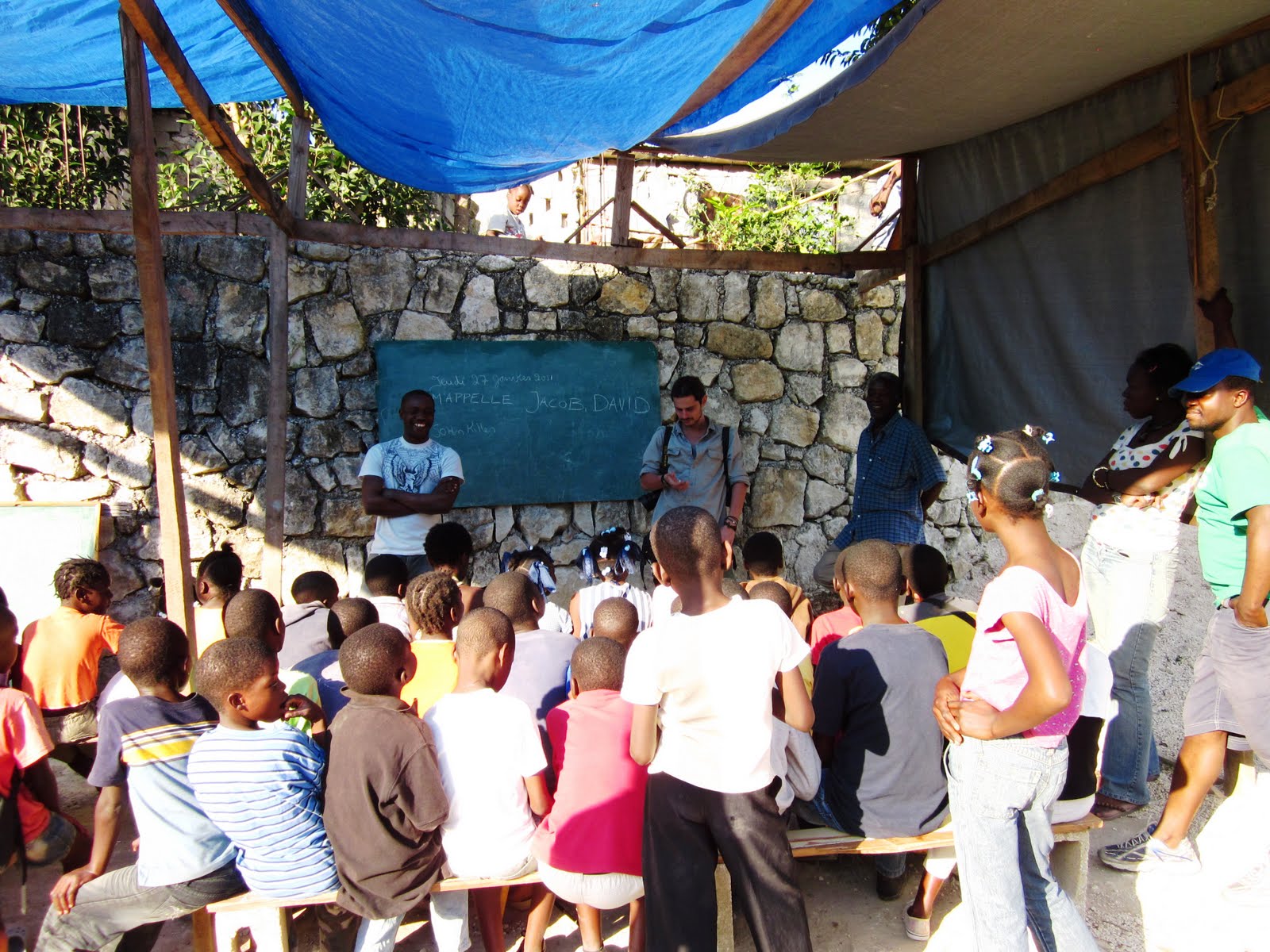
The next day we took the SantéBus to pick up some rice for the children of Pou Solèy Leve in the mountains. Pou Solèy Leve serves as an afterschool program for the children in the area. It is up in the mountains a little ways so it was nice and cool by the time we got there. After spending some time talking to the children and handing out the rice we came back down the mountain and to the house. The following day JP, Jacob (who decided he didn’t like the guest house and came to stay with us for the remainder of his time in Haiti) and I went to visit Double Harvest where they have hundreds of acres of food growing and people from the community working to help them. We then had dinner with the founder of World Wide Village and some members of a mission group that had just arrived. After that long day, we woke up early Monday morning to have a meeting with a well-respected lawyer to see what we could do about getting NGO (non-governmental organization) status. Once you have that status you are able to get things in the country duty free and should have an easy time getting things out of the port. We are going to work on getting that status but it takes a very long time and only one group has been able to get NGO status since the earthquake and that was Sean Penn’s group. For Dr. Bonnet’s last day here we had a meeting with the assistant director of the General Hospital to see what they could do to help us get the buses out of the post as soon as possible since they are under the director of the hospitals name. She said even they are having a hard time getting things out of the ports for cholera treatment. This is the same story we have been hearing from everyone, that they have either medical equipment, food, vehicles, shoes, or any other type of aid stuck in customs. Samaritans Purse was recently on Anderson Cooper taking him in a helicopter over the port to show him all of their containers that have been stuck there for weeks. After we dropped Dr. Bonnet off at the airport, Jacob, Yvon and I went to spend some time at the deaf camp. As Jacob was interviewing 2 young men about how their lives have changed since the quake, a little girl made a direct line for me and grabbed my hand and held onto my arm and wouldn’t let go. After that none of the children were shy anymore and were all trying to sit on my lap and play with my hair. When Jacob was finished with his interview and told us how it went he said he was surprised to find out that the people living there were much happier after the quake. The reason for this they explained was that before they did not know each other but after the quake there was an organization that helped them find each other and start their own community which is fenced in and they are building semi-permanent structures. Pou Solèy Leve would like to start a program for the children who live there and perhaps eventually a tutoring program because sometimes the parents cannot help their children with homework when they have a question due to the fact that they themselves are not educated or because they cannot communicate with their children. There is a big mobile medical unit that St. Clare’s Hospital donated which cost the $250,000 and we would like to ship it down and park it in the deaf camp with teams coming twice a week. We cannot ship it until we know for sure that it will not be sitting in the port for months. We also have another mini bus packed and ready to ship but again, we cannot have them sitting in the port for months at a time because by the time we finally are allowed to pick them up they aren’t working and we have to spend a lot of money to have a mechanic come and try to fix it. The port we ship the buses to is not the one in Port Au Prince but one about 2-3 hours away in Saint Marc. Hopefully we will be able to get the 3 buses stuck in Saint Marc out within the next few weeks, if not sooner. Along with working on our NGO status and a few other projects I am going to be quite busy but it will be good to see things advance and to see the country grow and help itself. The next few weeks are also going to be quite interesting due to the fact that on February 6th the country will no longer have a government because there were no run-off elections and everyone seems to think they won the majority of the votes. That is all for this week. Next week hopefully will not be so long.